There’s a version of ‘decluttering your home without overwhelm’ advice that sounds very impressive — and completely impossible to live with.
Pull everything out. Start fresh. Do it all in a weekend. That is not what you are about to read.
I’ve tried that approach. So many times.
I once spent an entire day recreating a beautifully organized pantry I had seen at a friend’s house — everything decanted, labeled, perfectly placed.
And for a few weeks, it worked.
Then life happened. And my pantry was a mess again.
Because the truth is: it’s one thing to organize your home.
It’s another thing entirely to keep it that way.
Anyone can carve out a weekend and make a dramatic dent.
But maintaining it is an entirely different skill.
And it’s one I had to learn over time.
So if you’ve ever felt like you’re either all in or completely behind, this is a different approach.
The 5-Minute Reset
You don’t need an hour. You need five minutes.
Set a timer. Pick a small area. Move quickly.
The goal is not perfection — it’s momentum.
A cleared counter, a reset living room, a floor you can see again…these small wins compound far faster than one dramatic, exhausting purge you’ll never want to repeat.
Most people don’t need a better system — they need a smaller starting point they’ll actually return to.
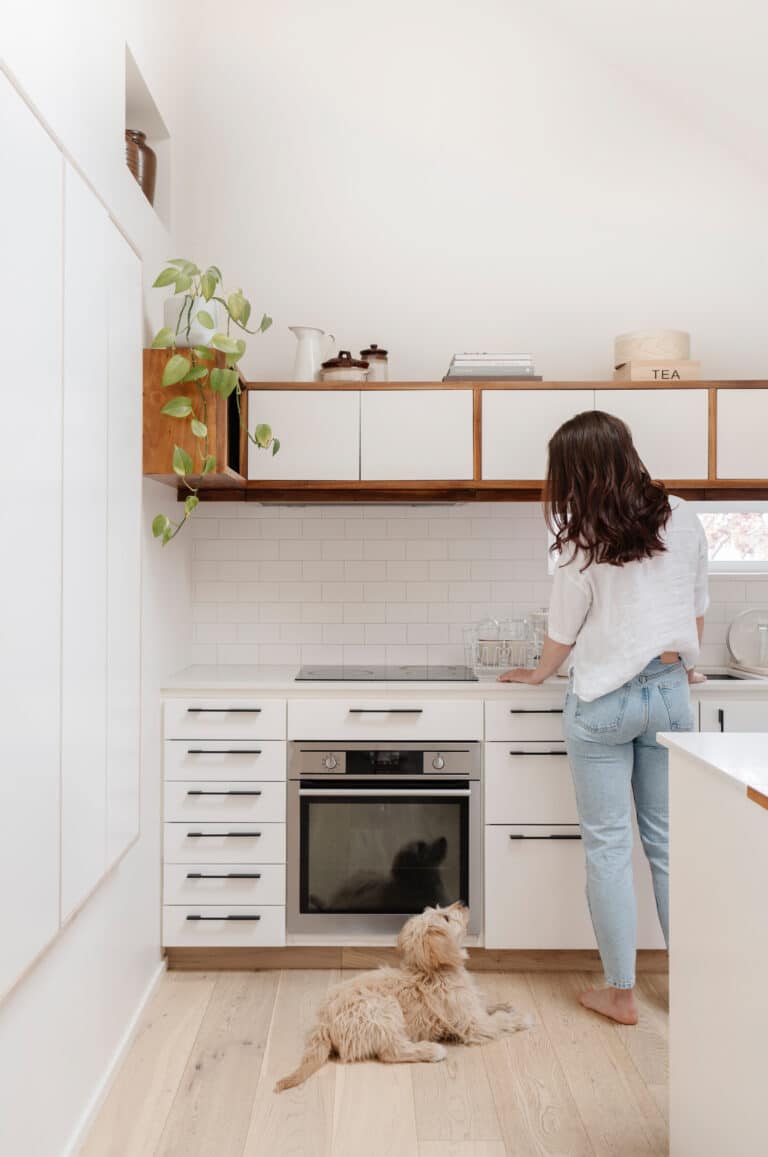
Keep the Kitchen (Mostly) Clean
If everything falls apart, this is the place to anchor.
Not perfect. Not spotless. Just… held together.
Dishes done. Counters mostly clear. Floors handled when you can.
A steady kitchen creates a quiet rhythm in the home. It keeps the day moving instead of stalling under the weight of yesterday’s mess.
Be Ruthless About What Comes In
Decluttering gets dramatically easier when less is entering your home in the first place.
Before you buy something, pause:
Can I borrow this? (hello, library)
Can I rent it? (hello, Nuuly)
Can I wait a week… a month… a season?
How long will it actually be here?
If a purchase isn’t a “heck yes!”, it’s a no.
Clutter doesn’t usually start with what we own — it starts with what we don’t question on the way in.
More often than not, clutter is a buying problem before it’s a decluttering problem.
This one mindset shift will do more for your home than any organizing system ever will.
Use Motivation That Actually Works
This works on kids — and it works on adults too.
Before something enjoyable happens, something small gets done.
Cupcakes are ready? Great — go pick up what’s on the floor, then come back and grab one.
Want to sit down and watch your favorite show? A quick reset happens first.
It’s not about punishment. It’s about pairing effort with reward in a way that keeps life moving forward.
Kid Clutter (Without Losing Your Mind)
Kids don’t need a lecture on minimalism. They need a simple loop:
Care for what you have → then receive more.
Before they get something new (or even something they really want in the moment), they reset their space.
It teaches ownership without turning you into the constant enforcer.
How to Let Go of Things You Love
This is soooo hard for me.
Especially as I am trying to spend less. I know I can’t just replace something later if I am to need it.
And I don’t do well with dropping meaningful items into a donation bin and walking away. I wish I did. I don’t.
What has worked for me:
Passing it to someone I know will use and love it.
Selling it through places like Rhea Lana’s, Just Between Friends, or Poshmark
I need to feel like it’s still being valued, not wasted but transferred to someone else who needs it.
Keeping something you don’t use keeps something hidden instead of honored.
From my shelf to someone else’s life — where it might actually be used, appreciated, and needed.
The Real Cost of Keeping Things
Your home is not free storage.
Think about what it costs to live there — your rent or mortgage, maintenance, taxes, utilities.
Now break that down:
What does one room cost?
How much space does this item take up?
You start to see it differently.
You’re not just keeping something. You’re housing it.
White Space Is the Point
White space is part of what makes a home feel calm — and quietly, a little more elevated.
Not every surface needs something on it.
Not every corner needs to be filled.
Empty space gives your eye a place to rest. It lets what you do keep actually stand out.
If you’ve ever wondered why some homes feel instantly more put together, it often comes down to this. I wrote more about that here:
→ How to Make Your Home Feel Expensive (Without Renovating)
Use the Time You Already Have
Decluttering doesn’t need a block of time. It fits into the edges.
Three minutes while someone looks for their shoes.
A few minutes while dinner finishes.
A quick reset before you leave the house.
Put on a podcast you love. Make it something you don’t mind returning to.
Small, consistent movement changes a home faster than waiting for the “right time.”
Clutter Is a Signal
I know. Don’t hate me yet.
It doesn’t feel like a gift — but clutter is often a signal.
A subtle check-engine light for an overfilled life.
When things start piling up, I’ve learned to look a little deeper:
Where am I over capacity?
What systems aren’t working — or not there at all?
What have I been prioritizing lately?
Sometimes it’s just a busy season.
Sometimes something is slightly out of alignment.
Either way, clutter rarely shows up randomly. It points to something underneath.
At one point, I had a box I kept adding to for years — things I didn’t want to deal with in the moment.
Years later, I realized it wasn’t about the box.
I just didn’t have a system — or the habit — for finishing decisions. So everything got postponed for “later.”
Eventually, later shows up.
For that box, later is now. Slowly and painstakingly, I’m working my way through it.
One Last Thought
You don’t need a perfectly minimal home.
You need a home that supports your life — one that can be reset, maintained, and enjoyed without constant effort.
That comes less from big, dramatic purges… and more from small, steady decisions made every day.